Biodiversity Research in the Amazon Rainforest


Highlights
- Get the experience as a biologist in one of the places with the greatest biodiversity in the world!
- Enjoy working surrounded by pure nature!
- Visit indigenous communities, caves, streams of crystalline waters, a boiling river and more!
- Learn about the customs and traditions of our Amazon communities while you volunteer with us!
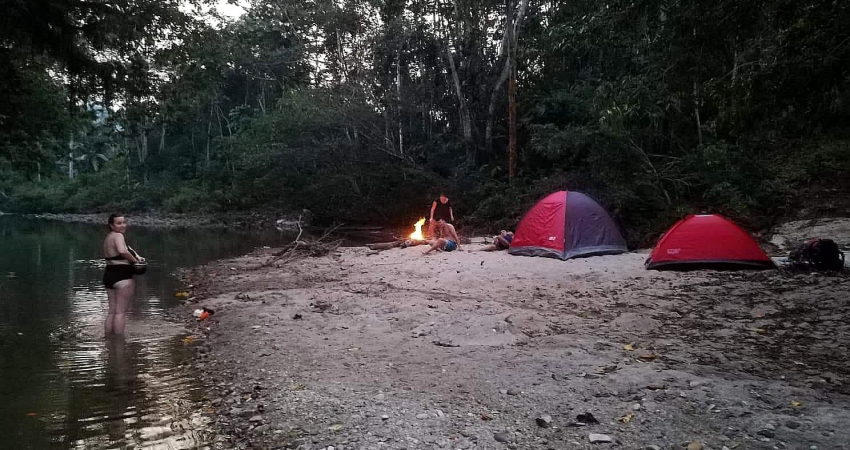
- Grab your tent and let´s explore the jungle!
Overview
People with special knowledge in the field of Biology could help us by observing and documenting different species in this rural area of biodiversity. The idea of this project is to be able to document all kinds of possible biodiversity through photos and videos in order to develop different types of teaching materials to share with the community and different Peruvian and international schools.
We will spend 10 days in the Amazon Jungle with a experienced guide who have worked with different international expeditions. The Expedition includes porters to transport our gear, enabling us to focus exclusively on looking for biodiversity and increasing the chances of once-in-a-lifetime experiences. We will use camera traps to capture as much wildlife as possible.
We need volunteers with studies in Biololgy, Biotechnology, Environmental, Zoology and Botany.
Desired skills:
-Photography
-Team work
-Introspection
-Camping
-Scout
-First aid
-Survival
-Communication and navigation techniques
Important Information
EL SIRA COMMUNAL RESERVE
WILD LIFE
One of the places in Peru that biologists, birdwatchers and explorers cannot miss is, El Sira Communal Reserve (Spanish: Reserva Comunal El Sira).
This is a protected area in Peru created on 23 June 2001 and located in three regions: the Huánuco Region (Puerto Inca Province), the Pasco Region (Oxapampa Province) and the Ucayali Region (Atalaya Province and Coronel Portillo Province).
The whole area is extremely rich in birds including many localized lowland and foothill birds such as Blue-headed Macaw, Curl-crested Aracari, Sulphury Flycatcher, Black-capped and White-bellied Parrots, Wing-banded Wren, Crested and Band-bellied Owls, Solitary Eagle, Koepcke's Hermit, Black-streaked Puffbird, Creamy-bellied Antwren, Peruvian Tyrannulet, Cerulean-capped and Jet Manakins, Fiery-throated and Scarlet-breasted Fruiteater, Olivaceous Piha and Rufous-brown Solitaire.
Of the mammals in the El Sira Communal Reserve, 54 species are of special importance due to a threat category, such as: giant armadillo (Priodontes maximus), pacarana (Dinomys branickii), river otter (Pteronura brasiliensis), tapir (Tapirus terrestris), Amazon River dolphin (Inia geoffrensis), manatee (Trichechus inunguis), bush dog (Speothus venaticus), spider monkey (Ateles belzebuth), jaguar (Panthera onca) and otter (Lontra longicaudis).
In addition, 203 species of BIRDS have been registered, especially the Passeriformes with 63 species. The Sira is one of the greatest areas of bird endemism of the planet (Peruvian East Andean Foothills). Among the most representative endemic species of birds is the Paujil del Sira or Piurí (Pauxi unicornis koepckeae), a subspecies of horned curassow that lives only in the El Sira mountain range.
The Sira curassow, a large bird in the Cracidae family is listed as Critically Endangered on the IUCN Red List. Also endemic are the Sira tanager (Tangara phillipsi) and the Sira hummingbird (Paethornis koepckeae).
Picture yourself walking among the ear-deafening noise of hundreds of parrots and macaws, an unforgettable cacophonic experience as you explore the Amazon jungle. Imagine having a close encounter with a beautiful male toucan, with his powerful and long beak, or seeing the colorful macaws as they soar above the trees. Experience the overwhelming image of a Marvelous Spatuletail (Loddigesia mirabilis) hauling his coin-sized tail discs or moving through the bushes at 14,000 feet.
There is also a large possibility of future scientific discoveries of species and subspecies of birds in areas of the reserve that are relatively inaccessible and that, as a consequence of their remoteness, may add new records of species not previously encountered.
In addition, some 105 species of reptiles have been reported, of the families of the Amphisbaenidae, saurians and especially snakes. Also 68 species of amphibians, mostly toads and frogs of the families Hylidae and Leptodactylidae, are known from the reserve. Finally, 111 species of bony fish have been reported, the most diverse being Characiformes.
FLORA
Some 190 species have been collected, including 8 endangered species, such as tall or red cedar (Cedrela odorata), mahogany (Swietenia macrophylla), quinilla (Manilkara bidentata), ceiba (Ceiba pentandra), ishpingo (Amburana cearensis) and palo rosa (Aniba rosaeodora). In the high parts the vegetation consists of trees with thin stems and small crowns, with a high presence of epiphytes: Bromeliads, orchids, ferns, Piperaceae, lichens, Sellaginaceae and mosses; while in the lower part there are taller and more vigorous trees with diameters exceeding 1.5m, in whose branches there is a varied plant community, composed of bromeliads, ferns, orchids and anthuriums, among others. There are 44 registered orchid species.
Write a Review
-
Mo Wildlife Conservation here!!!!
ATTENTION!:
If you are considering joining Semillas Life for a Conservation Ecology internship, please be very careful. The programme advertised is not what you actually get.I came here for 3 months with the goal of gaining practical experience in conservation ecology, but what I found was very disappointing and misleading:
There is no real team – only one person acting as a “supervisor”, and he has no proper experience in conservation ecology.
No lab, no equipment, no tools – not even a microscope or basic research materials. Apart from a few camera traps, there is nothing available to learn from.
No structured projects – it feels more like rushed jungle tours rather than conservation work. Nobody explains clearly what we are doing, why, or how.
Poor communication – the person in charge doesn’t speak English and makes no effort to explain things clearly. I had to study Spanish on my own just to keep up. Even then, everything is rushed, unclear, and poorly organised.
No teaching or mentoring – I was never given time to observe, learn methods, or work on proper projects. Weekly schedules were promised but never delivered.
Unprofessional behaviour – when I was sick and unable to join "activities", instead of understanding, my “supervisor” still forced me and when I refused he then ignored me.
No local management – Christian, who is supposed to lead Semillas Life, actually lives in Berlin and not in Peru, so there is no proper on-site management or support.
Also, the location is not Puerto Inca anymore, even though that’s what was advertised. I travelled to Puerto Inca on my own to investigate, and I was shocked – there is literally no forest left there due to deforestation. A genuine conservation ecology programme would have stayed in Puerto Inca and fought against that destruction. Instead, Semillas Life is based in Codo de Pozuzo, and while they claim to be doing “reforestation”, what I saw was just planting a few trees in a school backyard. Real reforestation should be happening in the forest, not in a yard where it has no ecological impact.
The living conditions are unacceptable:
The camp is dirty, dishes are left unwashed, food is left to rot, and hygiene is very poor.
The “rooms” are not proper rooms at all – they feel more like animal shelters.
When I left and booked myself into a hotel, I found a private room with my own bathroom and even a TV – and it was actually cheaper than what Semillas Life charges for their camp.
A real Conservation Ecology internship should include things like:
species monitoring, habitat assessments, biodiversity surveys, camera trap analysis, mark-recapture methods, GPS tracking, soil and water sampling, lab analysis, GIS mapping, climate change monitoring, and community engagement. None of these exist here.This is not a conservation or biological programme. At best, it’s a chance to walk in the jungle and get some general experience of the environment. The only positive for me is that I managed to record some footage for my documentary, but I had to look for serious conservation organisations on my own – at extra cost – to get proper learning opportunities.
Another intern who came here also struggled a lot because she needed help with her dissertation but got no support, no tools, and no proper guidance. She left very upset.
In my professional opinion (as someone who has taught conservation ecology at college level), Semillas Life is misleading interns and students by advertising a conservation ecology programme they simply do not provide.
If you are serious about learning conservation or ecology, I strongly recommend looking elsewhere. This is not the right place for it.
How this program can be improved?
Invest the money in tools and proper place and staff.